


 Print This Post
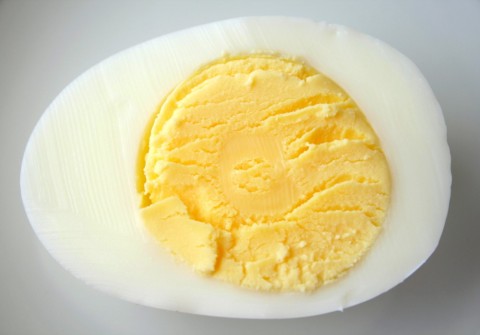
There are only a couple of simple secrets to cooking the perfect fool-proof hard-cooked egg — tender, no green ring around the yolk, easy to peel, ready for a meal or a snack.
Everyone needs to know how to make a hard-cooked egg. It’s really easy as long as you have a medium pot, some week-old eggs, and you remember to set the timer. For the sake of beginning cooks, I am giving detailed instructions.
This method of cooking makes the eggs tender but not rubbery, and cooling them quickly at the end helps to prevent that little green colored layer from forming around the yolk. *See below for your science lesson on why the green happens.
How to cook hard-cooked eggs
1. To hard cook eggs, buy large eggs a week before you plan to use them. We use older eggs for hard-cooked eggs because eggs 7-10 days old are easier to peel when boiled. But to be honest and practical, use what you have. On occasion I have hard-cooked freshly bought eggs and it has all worked out fine. If you have the luxury of planning ahead, get the eggs ahead.
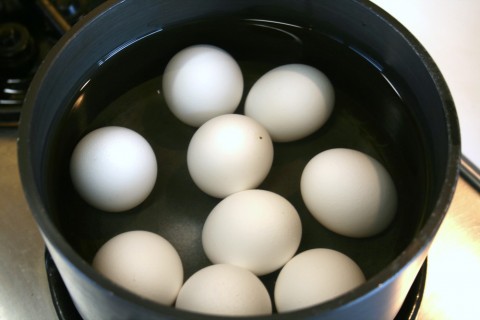
2. Place eggs in a medium-sized heavy pot, add a pinch of salt and cover with water by about 1-1 1/2 inches above the top of eggs. Cover the pot and heat until boiling. This will only take a few minutes (exact time will depend on size of pot, how much water is in it, how high your heat is, etc., so don’t leave the kitchen or you will come back to a furiously boiling pot and you won’t know how long it has been boiling).
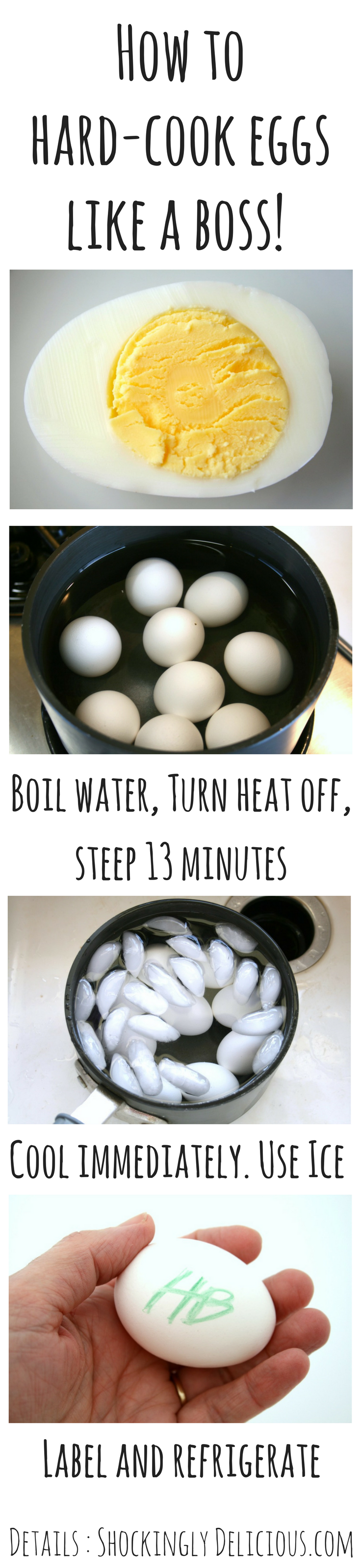
3. As soon as the water comes to a full boil (listen up, this is important!), turn heat off, leave pot lid on, and allow the eggs to sit in the hot water for 12 minutes. Set the timer so you are sure.
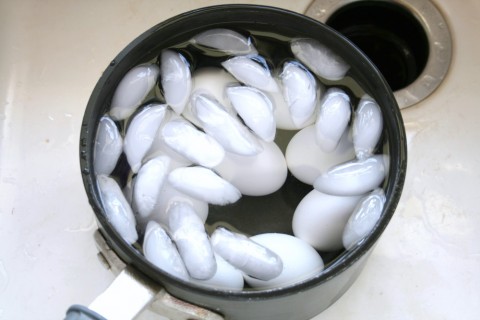
4. When timer rings, take the pot over to the sink, pour off the boiling water and run cold water over the eggs; pour water off again and replace with more cold water. Leave the pot with cold water in the sink until the eggs cool down. For more rapid cooling, I usually add ice to the cold water in the pot and let the pot sit for a few minutes. When eggs are cool, drain the pot and use the eggs, or label and refrigerate them.
There, that was easy, wasn’t it? Once you make hard-cooked eggs this way, you won’t have to ever consult this again. Just remember 12 minutes.
How to peel hard-cooked eggs
You can either bang the cooked and cooled eggs against each other in the pot (shake the pot back and forth a few times), or roll the egg on the counter under the palm of your hand. Then hold the egg under slowly running water as you peel the shell off. The water helps to loosen the rest of the shell as you are peeling.
(Also, the older eggs will aid in your peeling. According to Shirley Corriher in “Cookwise,” the ease of peeling is “related to pH, a measure of acid/alkaline levels. Older eggs, which have lost some of their carbon dioxide, are more alkaline, with a pH of 8.7-8.9 or higher. Hard-cooked older eggs are easier to peel than fresh eggs. Because you want to keep this high level of alkalinity, you should NOT add vinegar to the cooking water,” she says. Also, quick cooling helps with easy peeling.
Label the hard-cooked eggs
There are two easy ways to label hard-cooked eggs that will be refrigerated after cooking. Why label? Because a hard-cooked egg in a white shell looks eggsactly the same as a fresh egg in a white shell.
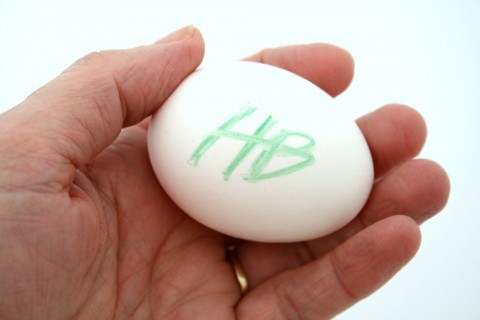 Mark on the shells with a pencil or marker so you can tell which ones are cooked. In my childhood, there was often a bowl of eggs in the frig with the letters “HB” on them (for hard-boiled).
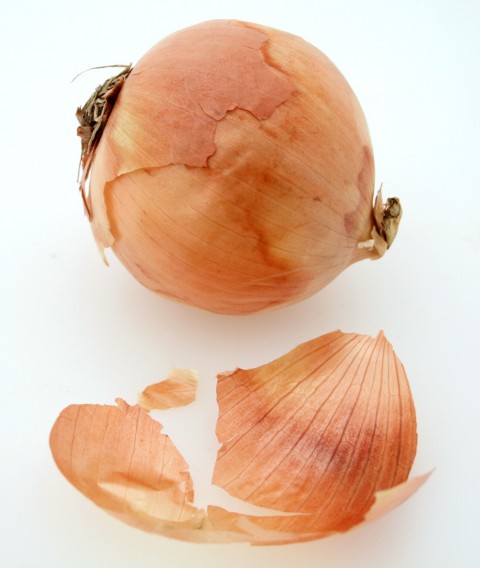 Or, when you place the eggs in the pot, add some papery onion skin (either from yellow or red onions) along with the salt and water. The onion skin will dye the egg shells lightly during the cooking/steeping time, and you will have colored egg shells which can signify hard-cooked eggs to you.
What to do with the used egg shells
Turn them into the soil in your garden and bury them, or throw them in your compost heap. Yes please, either one.
*A science lesson about the green ring around the yolk
*What is that green layer that forms around the yolk sometimes? According to food sleuth Shirley Corriher, that ugly green stuff is the “result of iron in the yolk combining with sulfur in the white to form green iron sulfide. While the egg is cooking, heat speeds up the chemical reaction. The longer the egg cooks, the greater the chance for discoloration, so watch the time carefully. Quick cooling also helps prevent the green layer from forming.” (There is nothing wrong with the green stuff other than its appearance.) Now you know.
(Source: “Cookwise: The Hows & Whys of Successful Cooking,” by Shirley O. Corriher.)
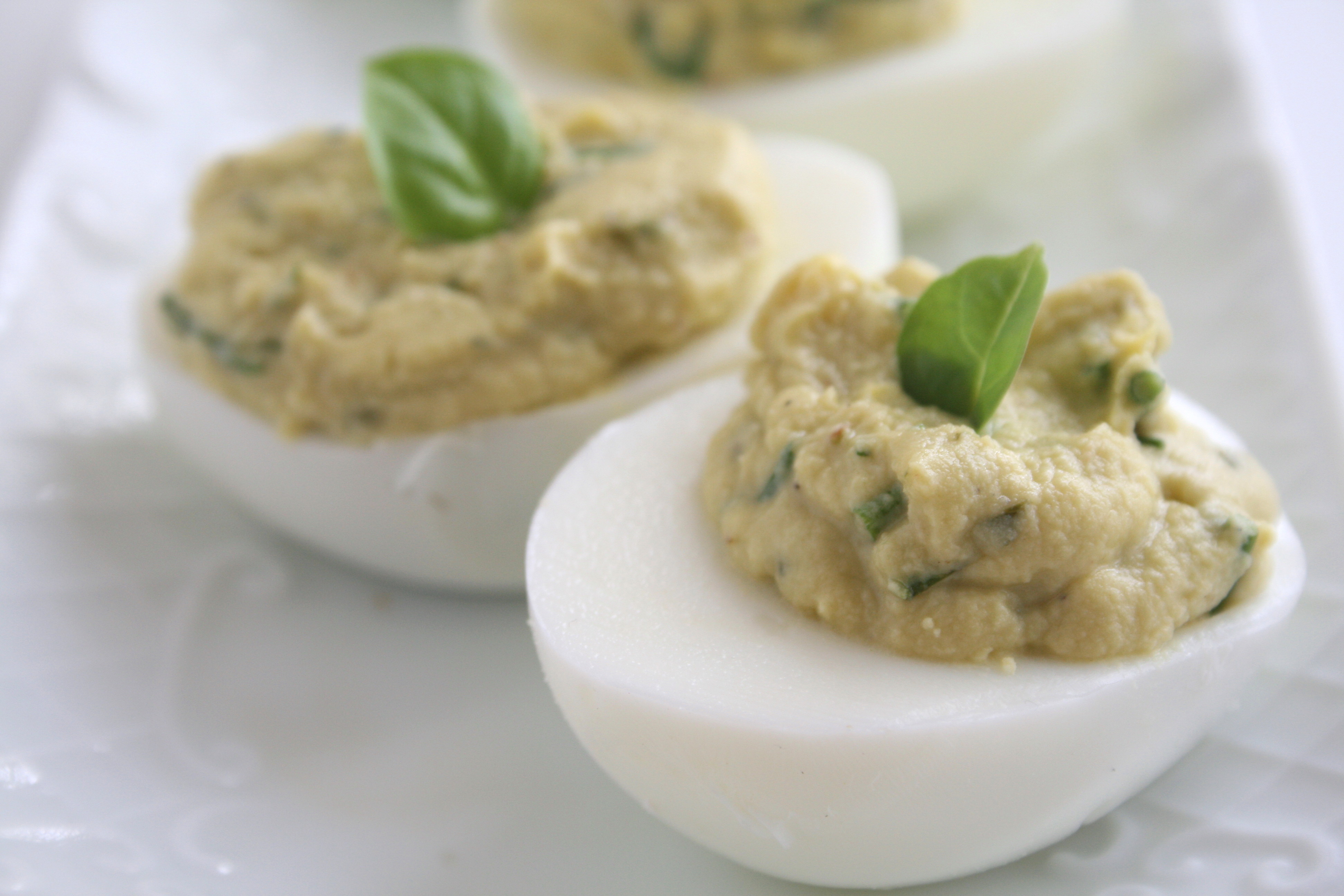
To practice your new egg skill, you might like to try these recipes that use hard-cooked eggs
 Pin the image below to your Pinterest board to save this method.
There you have it…eggsactly perfect eggs!
This post was originally published Oct. 24, 2010, and has been refreshed and republished today.
 Welcome to my kitchen!
At ShockD, you’ll find scrumptious, tried & true, "scary good" recipes, tips and coaching to make YOU a fabulous home cook! Don't blame me if you need a 12-step program to wean yourself away!
E-mail me: Dorothy.Reinhold@gmail.com
Welcome to my kitchen!
At ShockD, you’ll find scrumptious, tried & true, "scary good" recipes, tips and coaching to make YOU a fabulous home cook! Don't blame me if you need a 12-step program to wean yourself away!
E-mail me: Dorothy.Reinhold@gmail.com


{ 28 comments… read them below or add one }
Next Comments →
Thanks for all the tips!
This is such an awesome tutorial! I can’t wait to try this out!
This is just how I make my hard boiled eggs! And my grandmother always marked hers with “HB” and I do the same now.
Love this! Great tips! I love the labeling idea!
Labelling is such a great idea!
We love hard boiled eggs at my house! Thank you for the tips. I didn’t know older eggs were easier to peel, which is usually one of the big issues I have!
Ashlyn,
Yep, don’t buy ’em and boil ’em right up. Let them “age.” 🙂
Great tips, and I love the science behind the cooking method!
This is a great post! I always cook them exactly like you do but I usually adjust the time a minute or 2 for larger or smaller eggs. My friends and I got on this topic a few years ago at a ladies retreat (One of them has a husband who trained at the Ny Culinary Inst). All 3 of us did them differently, so we put all three methods to the test. We all agreed the eggs turned out best with this method! 🙂
Beth,
How great is that to hear! You’re right….with tiny eggs, a minute or 2 less, with huge ones, a minute or 2 more. Perfect!
Great tips on the perfect hard boiled egg and labeling them to identify them quickly in the fridge
Great information. So good to know the “why” along with the “how.”
Great tips! I especially like the idea of labelling the eggs, why have I never thought of that!
Love the idea of boiling up a batch and having them labelled in the fridge for later! Great tip!
Yes, we don’t want the dark layer around the yolk! Egg cooking tips are always handy. Thanks for this. I am still learning and perfecting the art of soft-boiled eggs. I think 7 minutes is my sweet spot for a creamy yolk. 🙂
Christine,
I will bow to your timing expertise on the soft-boiled eggs. I personally need my yolks firmer than that. 🙂
This method does not work at high altitudes. The water boils faster, because of less surface pressure. I usually let them boil for a few minutes in order to get to a hotter temp., and then put a lid on and turn off the heat.
No need to mark the eggs. Quick tip if you happen to mix them up between raw and hard boiled–spin it on the counter. The raw egg will spin slowly and wobbly because if the imbalance with the yolk. The hard boiled will spin fast since it’s all solid.
Brandy,
Righto! I just think it’s visually easier to put a mark on them. And that way my kids know which are hard-cooked when they are looking for a snack, too. Cheers!
My boy just asked me to make some hard-boiled eggs–don’t mind if I do!
Oh, and by the way, I only cook bacon in the oven now…genius idea. Thank you for that.
Susie,
Eggs are easy once you know the trick.
That bacon (https://www.shockinglydelicious.com/shockinglydelicious-saturday-cooking-class-bacon-in-the-oven/) is rockin’ great, isn’t it?
I’ve made many h.b. eggs over the years, trying many “recipes,” and I always have to go back and consult the books to remember the times. Made yours tonight and they turned out exactly like the picture–we’ll keep to the 13-minute-recipe from now on! (The boy scarfed down the first egg white, and we fed the yolk to the dogs…spoiled canines 😉
Thanks for the answer. I’m going to try this and will report back. I want my HB eggs to look like that picture — that yolk is so creamy perfect I first thought it was buttercream frosting!!! “-)
Thanks, Rene! I think NOT overcooking the egg is the ticket to a perfectly creamy yolk.
EGG-cellent tutorial. If you are going to keep the eggs for awhile, do you suggest peeling them, or leaving them in the shell until you are ready to eat them? (I would like to make a dozen eggs on, say, a Sunday night and use them throughout the week for my lunch bag.) I am going to try this with your old eggs / 13 min. suggestions. I always seem to have a hard time getting the shells off, but then again I am pretty sure I am always using fresh eggs. Thanks.
Hi Rene,
I often do as you want to do — make 9-12 hard cooked eggs on a weekend, and use them throughout the week. I leave them in the shell. Yes, using older eggs is really crucial to the easy peeling. When I know I am going to hard cook a ton of eggs for, say, Easter, I might even buy them 2 weeks ahead. According to Shirley Corriher in “Cookwise,” the ease of peeling is “related to pH, a measure of acid/alkaline levels. Older eggs, which have lost some of their carbon dioxide, are more alkaline, with a pH of 8.7-8.9 or higher. Hardcooked older eggs are easier to peel than fresh eggs. Because you want to keep this high level of alkalinity, you should NOT add vinegar to the cooking water,” she says. Also, quick cooling helps with easy peeling.
There you have it….eggsactly perfect eggs!
Excellent tutorial on hard boiling eggs!!! Aging the eggs definitely helps with the peeling since the volume of the egg decreases as it ages which leaves a bigger airspace and as you said makes the peeling easier!!!
funny thing my husband recently said when trying to help out by cooking — “how many hours do you boil the eggs?”…